
Back in late July/early August, we spent a week in a village called Sikalele. One day, as we were walking around, going hut-to-hut, doing ministry, we encountered a young woman, whom I would guess was in her 20s, and her grandmother.
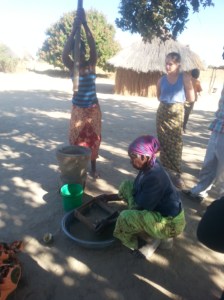
When we arrived at their home, they were in the process of grinding (with a large wooden mortar and pestle) and sifting millet. We didn’t have a ton of time to spend with them because it was nearing the end of the day, so it would have been easy for us to just jump right into sharing the Gospel with them. However, we know that one of the best things that we can do is participate in their daily lives. It shows them an immense amount of love (especially since they’ve often heard that white people are prideful–it is this reason that they are shocked and amazed whenever we choose to sit willingly on the dirt instead of on a stool) and many times, they find it very amusing, depending on the task.
So we asked them if they would teach us how to do it. They smiled and laughed as each of us took a turn first at the grinding, then the sifting. Robbie went first, and he was apparently very good at working the mortar and pestle because they joked that he could easily get a Zambian wife. (It is, of course, not traditional that a man would do this type of work). Then all of us girls tried, with Charles mixed in the middle. They told us we were pretty good at the sifting but terrible at the grinding. They joked that we would have a hard time getting husbands. We laughed. So did they.
But the fact of the matter is that this is their reality. It is still traditional practice that a woman’s value is determined by her ability to do housework and cook and bear children, and as a result, her ability to get a husband. She does not, however, get to pick her husband. If she is deemed “good enough” at her appointed tasks, a man will choose her. She has no say. Then the man will pay the bride’s family whatever he determines her value, her price, to be–usually payment in the form of cows. So a Zambian woman’s value is based on this question: How many cows is she worth? And when a marriage begins with a question like that, the following years are typically filled with similar thoughts and questions that continue to objectify and degrade the woman.
Now before you let that shock you too much, think about this: how many women in the western world, whether by themselves or someone else, have their value determined by whether or not a man wants them? I know I still struggle with that.
Therein lies the beauty in missions. My typical daily life doesn’t include walking [up to] several miles to get water or grinding millet with a mortar and pestle or cooking over a fire. Their daily lives don’t include flushing a toilet or watching television or reheating something to heat in the microwave. But on the inside, we are all the same. Emotions, feelings, and struggles are universal. I can take my own personal story of battling heartbreak and depression and self-worth, and I can look into the brown eyes of a beautiful Zambian woman and share it. And I can share how beautiful and special and loved they are to Christ.
And we have male missionaries who have both taught men about the value of women and how they are called to love their wives and apologized to Zambian women on account of all men.
My primary point in this is that the most powerful thing you can say to anyone–whether locally or abroad–is your story. Never never think that you don’t have enough knowledge or skills or experience to share the love of Christ with someone. You just never know who may relate to and be forever changed by your story.
 The Living One Blog